
Beyond the Property Line: Provençal Sheet-Pan Chicken & Keenan 2023 Ghisletta Merlot
What wine goes with roast chicken? A soft, generous red like Keenan’s 2023 Merlot from Ghisletta Vineyard in Napa Carneros. Big, grippy reds can bully roast chicken; this Merlot’s soft tannins don’t. Its red cherry fruit plays against salty olives and sweet roasted garlic, its herbal side lines up with rosemary and fennel, and its fresh acidity keeps crisp skin and a butter pan sauce from feeling heavy.
Download the printable recipe (PDF, 4 pages) ↓
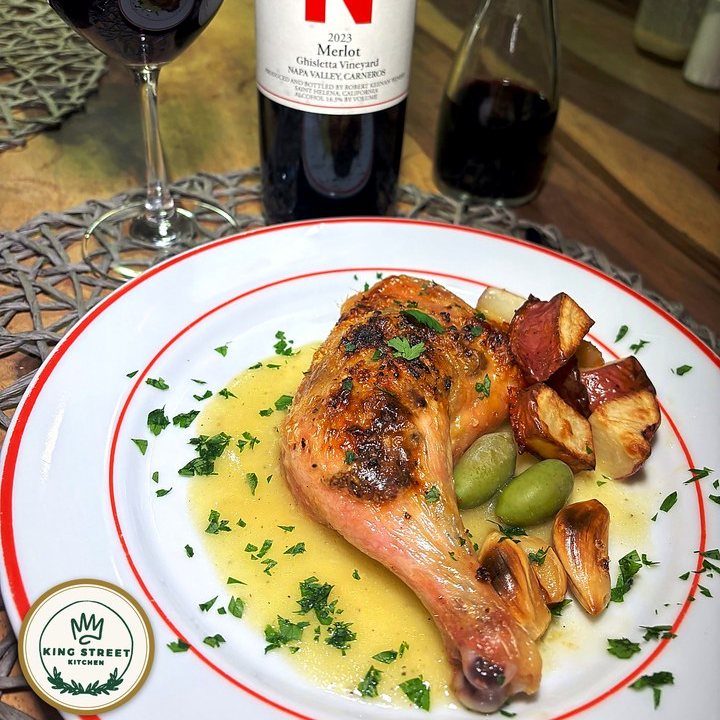
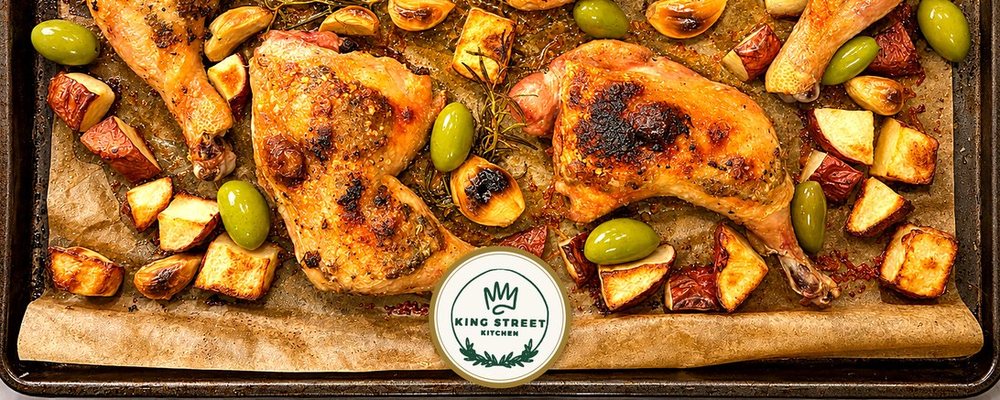
A Provençal sheet-pan supper of crisp-skinned chicken legs, olives, roasted garlic and potatoes, with the Keenan 2023 Merlot, Ghisletta Vineyard, Napa Carneros in the glass.
Wine with food
A reason to reach beyond the fence
Owning a vineyard matters. So does knowing when a vineyard you don't own has something to offer.
Michael Keenan understands both. Keenan's home is Spring Mountain, where estate Merlot grows dense and powerful. Starting in 1989, the winery bought Merlot from Carneros, the cool southern tip of Napa near San Pablo Bay, to soften that power in the blend. In 1999, the Carneros fruit was so good it earned a bottle of its own.
Today that wine comes from Ghisletta Vineyard, in the northwest corner of Carneros, where Michael says it's a little warmer and sunnier. To Michael, Merlot is the best red grape Carneros grows. Only 394 cases of the 2023 vintage were produced, and most of them go to Keenan's wine club.
I asked Michael what makes it special. He talked about classic Merlot "stink," his word for sweet fruit wrapped in a light touch of herbs and spice. Red cherry leads, with a hint of rhubarb, a signature of Carneros. The tannins are soft and the texture is round. In other words, pure pleasure.
That told me how to cook. Toasted, crushed fennel seed and rosemary echo the herbs. Garlic roasted whole turns sweet and soft. Green olives bring a savory, salty edge. Golden potatoes soak up the pan juices, and a glossy sauce ties it all together. Nothing shouts. The chicken simply meets the wine halfway.
At King Street Kitchen, the cook isn't the hero. The farmer is. And the best winemakers understand that great wine begins long before the grapes reach the cellar. Michael Keenan knows when exceptional fruit deserves to stand on its own.
Excellence isn't necessarily defined by a property line. It's defined by the care, judgment, and commitment behind what ends up on the table.
Serves 4 · Hands-on about 20 minutes · Roast 40–50 minutes, plus 5 minutes rest · Dry brine optional, overnight ideal · Wine Keenan 2023 Merlot, Ghisletta Vineyard
Why chicken legs?
Why whole legs? A whole leg is the thigh and drumstick still joined. It's dark meat, so it stays juicy, costs less than breasts, and is very hard to overcook. The skin and bone protect the meat while the oven does the work.
Dry skin is crispy skin. Moisture is the enemy here. Dry the chicken thoroughly so the oven can get straight to browning instead of spending its energy evaporating water. Pat the legs dry and, if you have time, leave them uncovered in the fridge overnight with the salt on them. That's called a dry brine. It seasons the meat and dries the skin at the same time.
Flavor under the skin. The rub goes under the skin, right on the meat. The garlic and lemon zest flavor the chicken without burning, and the skin on top still crisps.
Faster than you think. About 20 minutes of hands-on work. The oven does the rest while you make the sauce, set the table, and open the Merlot.
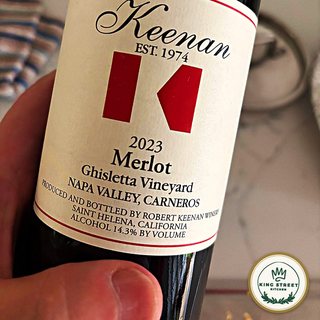
The wine: 2023 Merlot, Ghisletta Vineyard, Napa Carneros
Michael Keenan's notes: true Merlot character, with sweet fruit balanced by a light touch of herbs and spice. Red cherry leads, with a hint of rhubarb that he calls a classic Carneros marker. Soft tannins and a round, generous feel. "Great Merlot identity, soft tannins, round pleasure-giving mouthfeel," as Michael puts it.
- Variety: 100% Merlot
- Vineyard: Ghisletta, Napa Carneros
- Alcohol: 14.3%
- Acidity: 0.67 g/100 mL
- pH: 3.30
- Sugar: Dry
- Bottled: May 8, 2025
- Production: 394 cases
Why this pairing
Big, grippy reds can bully roast chicken. This Merlot's soft tannins don't. Its red cherry fruit plays against the salty olives and sweet roasted garlic, and its herbal side lines up with the rosemary and fennel. The wine's fresh acidity keeps the crispy skin and butter sauce from feeling heavy. Each one makes the other taste better.
Ingredients (serves 4)
- Chicken legs: 4 whole legs, bone-in and skin-on, about 2½ lb total
- Kosher salt: 2 tsp Diamond Crystal (using Morton? use 1 tsp; it's saltier by volume)
- Extra-virgin olive oil: 2 tbsp for the rub, plus 1 tbsp for brushing the skin (or a few sprays from a mister)
- Garlic: 2 cloves, microplaned, for the rub; 8 whole cloves, peeled, for the pan; 1 clove, microplaned, for the sauce
- Lemon: 1 medium, zested, then cut in half (save the halves)
- Fennel seed: ½ tsp, toasted and lightly crushed
- Black pepper: ½ tsp, freshly ground
- Rosemary: 1 sprig, leaves finely chopped, for the rub; 2 whole sprigs for the pan
- Red bliss potato: 1, about 8 oz, skin on, cut into 1-inch cubes
- Olives: ¾ cup, Castelvetrano and/or Niçoise
- Fresh parsley: 2 tbsp, chopped, to finish
- Salted butter: 2 tbsp, for the sauce
- Chicken broth: 1 cup
- Cornstarch: 1 tsp mixed with 2 tbsp cold water, optional, for a thicker sauce
Key equipment
- Rimmed sheet pan and parchment paper
- Microplane: a fine rasp grater, for the garlic and lemon zest
- Small skillet, small saucepan and a pastry brush
- Instant-read thermometer: the only way to know the chicken is done
The method
1. Dry and salt. Pat the chicken very dry with paper towels. Season all over with the salt. If you have time, set the legs on a rack or plate in the fridge, uncovered, for a few hours or overnight. That's the dry brine. No time? Keep going.
2. Heat the oven. Heat the oven to 425°F with a rack in the upper-middle position. Line a rimmed sheet pan with parchment.
3. Toast the fennel. Set a small dry skillet over medium heat. Add the fennel seed and shake the pan for 1–2 minutes, until it smells fragrant and darkens a shade. This is called toasting (some cooks call it blooming): the heat wakes up the oils in the spice. Move the seeds to a plate right away so they don't burn. Once cool, crush them lightly with the side of a knife.
4. Make the rub. In a small bowl, stir together the 2 tbsp olive oil, microplaned garlic, lemon zest, crushed fennel, pepper and chopped rosemary. Why microplane? It crushes the garlic more completely than chopping, which sets off the reaction that makes allicin, the compound behind garlic's punch.
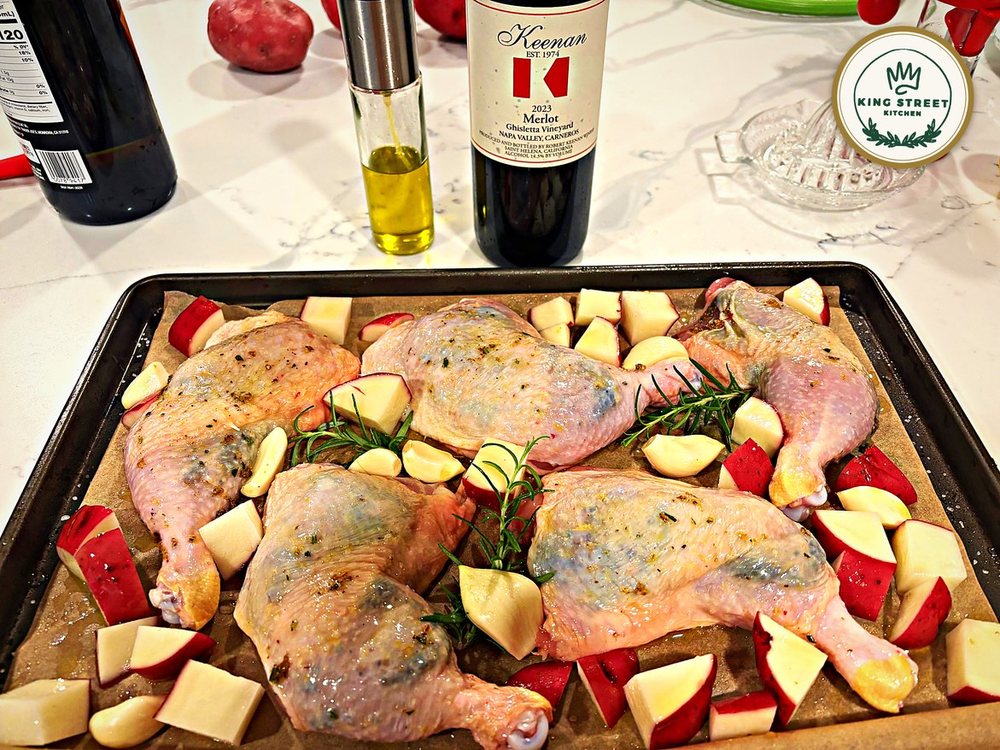
5. Rub under the skin. Gently loosen the skin with your fingers and push most of the rub underneath, onto the meat. Smear what's left on the outside. Under the skin, the garlic and zest won't scorch.
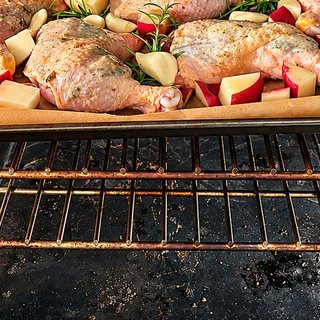
6. Load the pan and brush. Place the legs skin-side up on the pan with space between them. Crowded chicken steams instead of browning. Brush each leg with the 1 tbsp olive oil. Scatter the potato cubes, whole garlic and rosemary sprigs around the chicken. The potatoes go in raw; they'll cook in the chicken's juices.
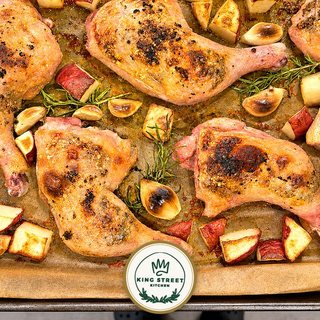
7. Roast. Roast for about 35 minutes, until the skin is golden.
8. Make the sauce. While the chicken roasts, melt the butter in a small saucepan over medium-low heat. Add the microplaned garlic and stir for 30–60 seconds, until fragrant. Don't let it brown. Add the broth and simmer until it's reduced by about a fifth, about 5 minutes. For a thicker sauce, stir the cornstarch into the cold water, whisk it in, and simmer 1 minute until glossy.
9. Add the olives and finish. Scatter the olives around the chicken and roll the garlic and potatoes in the pan juices. Roast 5–10 minutes more, checking the temperature: push an instant-read thermometer into the thickest part of a thigh, without touching the bone. Pull the pan at 175–185°F. It must read at least 165°F, the safe minimum for chicken; dark meat gets more tender at the higher temperature. Big legs can take longer, so trust the thermometer, not the clock.
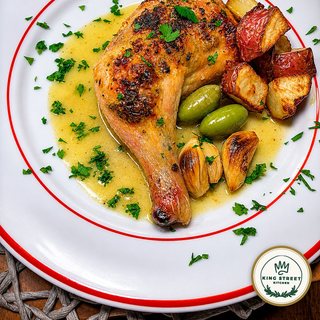
10. Rest and finish. Rest 5 minutes. Squeeze lemon juice over the pan to taste, starting with half a lemon, and spoon the juices over the chicken. Plate each leg with potatoes, olives and garlic, spoon the warm sauce around it, and scatter parsley on top. Squeeze a roasted garlic clove into the sauce on your plate. Pour the Merlot.
Sourcing and variation notes
The chicken. Buy the best you can. My first choice is a local farm or pasture-raised chicken, but good grocery-store legs work well too. Bone-in thighs work too; check the temperature a few minutes early.
The olives. I used Castelvetrano: bright green, mild and buttery. Niçoise olives are small, dark and briny, the classic choice in Provence. Use either or both. If yours have pits, warn your guests.
Raw or parboiled potatoes? I put mine in raw, and 1-inch cubes cook through in the roast time. Want creamier centers and crispier edges? Boil the cubes in salted water for 5–7 minutes and drain well first. It costs you one extra pot.
The sauce. Store-bought or homemade broth both work. Choose low-sodium if you're watching salt. The cornstarch is optional: it adds less than 1 gram of carbs per serving. Skip it and simmer the broth a little longer instead.
Why parchment? Easy cleanup. The trade-off: potatoes brown a little less on parchment than on a bare pan. Mine still got good color.
Cherry tomatoes. In summer, scatter a cup of them in with the potatoes. I left them out because they're not in season. I cook with the season when I can.
An honest word about the potatoes. One potato for four people. That's about 2 ounces each, or 9 grams of carbs: enough to soak up the sauce, not enough to take over the plate. Carbs stay around 10% of calories. Doubling the potatoes still keeps it near 15%.
Leftovers. Refrigerate within 2 hours; eat within 3–4 days. Reheat the chicken in a 400°F oven to re-crisp the skin. Warm the sauce gently. Cold leftover chicken is great over a salad.
Nutrition, estimated per serving
As made (a quarter of the recipe): about 600 calories; 34g protein (23% of calories); 45g total fat (67%); 15g carbohydrate (10%). Without the potato: about 560 calories; 33g protein (24%); 45g fat (72%); 6g carbohydrate (4%).
Key micronutrients, mostly from the dark meat: selenium about 30mcg (55% DV), B3 (niacin) about 7mg (44%), zinc about 3.3mg (30%), B6 about 0.45mg (26%), iron about 2mg (11%).
Sodium is about 1,100mg per serving (an estimate). It comes from the salt, the olives and the broth. To trim to roughly 800mg, depending on the brands you use: use 1½ tsp Diamond Crystal, low-sodium broth and unsalted butter.
How we got here: 2½ lb of bone-in legs is about 7 oz of meat and skin per serving, raw. We assumed about a fifth of the chicken fat stays on the parchment. Includes the olive oil, olives (about ¾ cup), one 8 oz potato split four ways, and the sauce with cornstarch. Carbs are total, not net (about 2g fiber). All values are estimates.
The vineyard and the winery
Ghisletta Vineyard, Napa Carneros. Carneros is the southern end of Napa Valley, closest to San Pablo Bay. The bay keeps it cooler than the rest of the valley, and it's known for Chardonnay, Pinot Noir and Merlot. Ghisletta sits in the northwest corner, which Michael says is a little warmer and sunnier. Keenan bottled its first Carneros Merlot on its own in 1999 and still makes only a few hundred cases most years.
Keenan Winery, Spring Mountain District. Robert Keenan founded the winery in 1974 on Spring Mountain, high above St. Helena. Today Michael Keenan and his son Reilly farm the estate vineyards. The Ghisletta Merlot is one of the few Keenan wines grown off the estate, and most of it goes to wine club members. Keenan Winery, St. Helena, California, on (707) 963-9177.
King Street Kitchen, in partnership with Preston-Layne & Partners, is a contracted brand ambassador for Keenan Winery, representing the wines across the eastern United States. All other producers named here are featured because we believe in them and use their products ourselves.
"Source the Best. Cook the Truth. Serve the Soul." Cook with a purpose.